

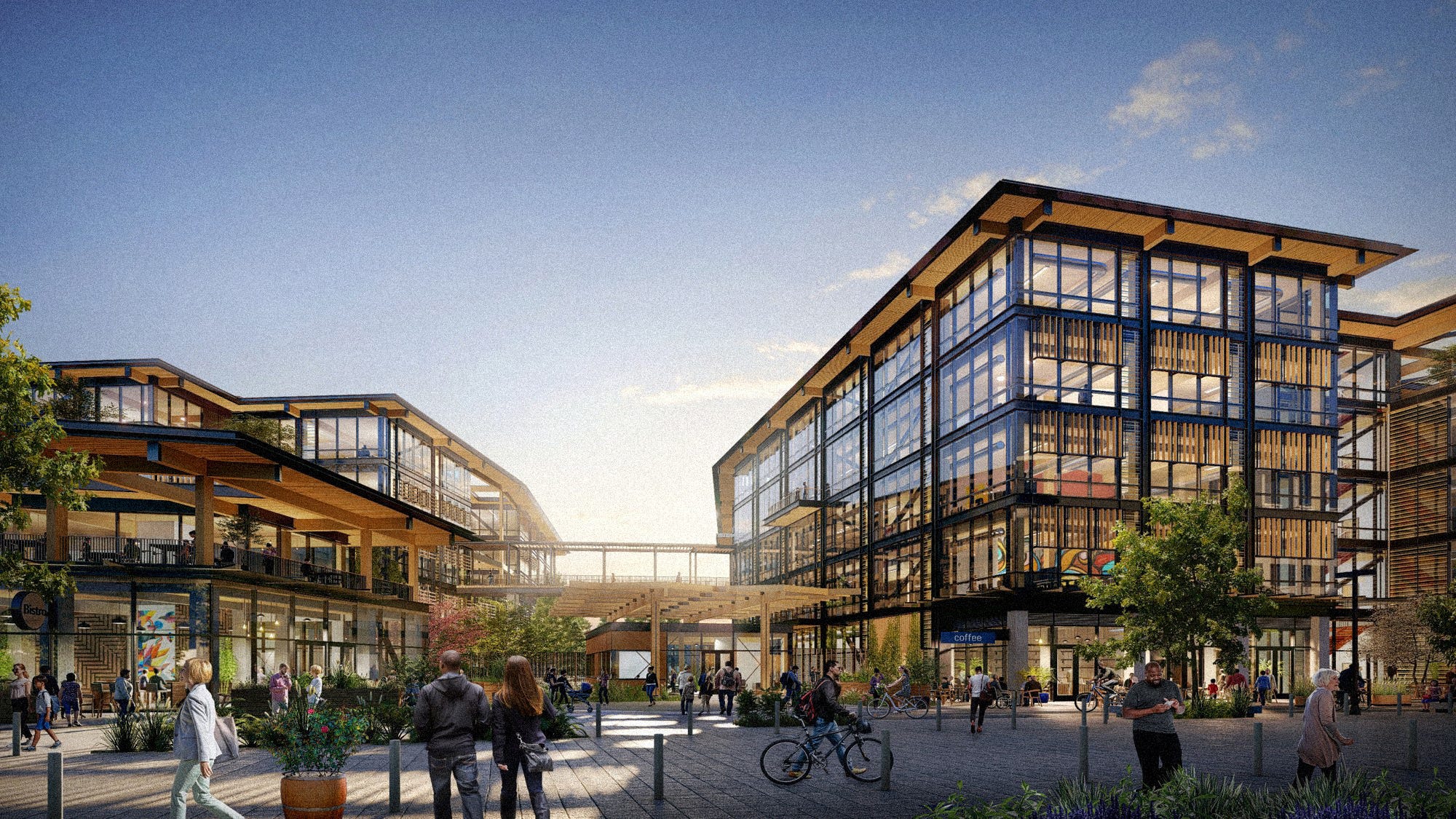
When cities rely on tech giants to build basic necessities like affordable housing and grocery stores, local communities are left at the mercy of corporate whims. Meta’s sudden project freeze proves that when tech priorities shift from physical neighborhoods to AI, everyday residents may be the ones left stranded.
On May 1, 2026, Meta abruptly placed its 59-acre Willow Village development on hold. The company blamed “shifting real estate market conditions and evolution in space requirements,” framing the choice as a routine corporate space adjustment following the remote-work boom. In Menlo Park, however, the pause struck a devastating blow. The project was supposed to transform the older Menlo Science & Technology Park next to Meta’s headquarters into a thriving mixed-use district. Meta’s spokesperson stated that the current economic climate no longer supported “a project of this type and scale.” With that single sentence, Meta reduced a severe housing and amenities crisis to a simple matter of private feasibility. Nearby Belle Haven residents must now continue waiting for promised neighborhood services, trapped by corporate choices over which the city has little influence.
This dynamic redefines classic political economy. For decades, urban theorists described cities as growth machines driven by coalitions of local developers, banks, and civic boosters who combined forces to intensify land use.1 In Silicon Valley, however, power has concentrated far beyond this traditional model. What has developed here is a stark form of corporate-dependent municipalism, where a single platform monopolist commands the local state. Instead of local elites coordinating regional growth, a global corporation uses the city as a speculative spatial fix—a temporary geographic container for its capital.2 Menlo Park holds formal planning authority, but it has bound the actual delivery of housing, retail, and civic repair directly to Meta’s corporate expansion strategy.
Highway 101 and an unequal distribution of public and private investment have long isolated Belle Haven from the rest of Menlo Park. A resident told the local newspaper The Almanac that the neighborhood lacks a pharmacy, a bank, and even a post office. Instead, residents rely on a solitary gas station, a few small restaurants, and bodegas, facing a distinct sense of enclosure whenever Willow Road becomes impassable. The approved master plan outlined up to 1.6 million square feet of commercial space, including 1.25 million square feet of offices and 200,000 square feet for retail, grocery, and pharmacy services. More importantly, it included up to 1,730 multifamily housing units—featuring 312 below-market-rate units and 119 senior units—alongside a 3.5-acre park, a 1.5-acre town square, a dog park, and a 2-acre elevated linear park.
This sudden freeze derails the city’s broader civic strategy. Menlo Park had integrated these 1,730 units directly into its official 2023–2031 Housing Element plan to meet state requirements. Yet, at the May 2026 Planning Commission review, commissioners found themselves legally handcuffed, ruling Meta in “good-faith compliance” because the development agreement ties corporate obligations to future construction milestones rather than current progress. While the agreement remains in effect and annual compliance reviews will continue, the pause exposes a deep institutional vulnerability. The city had already warned that “everything has to go perfectly” to hit its housing targets. Commissioner Misha Silin summarized the institutional trap perfectly, warning that Menlo Park should “not rely so heavily on third parties that are acting in their own best interest.”
This reliance shifts cities into entrepreneurial roles, forcing them to actively bargain for investment through speculative public-private partnerships rather than governing from independent public capacity.3 This arrangement does not mean the local state disappears; instead, it works intensely behind the scenes. Menlo Park spent years rezoning, reviewing, negotiating, and monitoring this project. The real contradiction is that public authority operates through market dependence and corporate execution. This creates a governance model that stretches far beyond traditional public institutions—an arena where public agencies, private firms, and community groups all negotiate, but where power remains starkly unequal.4 Meta secured widespread civic legitimacy by promising public benefits, yet retained absolute control over the project’s timing, sequencing, and ultimate survival.
The Backstory—From Land Conversion to Civic Grammar
Meta never intended to replace the local government or directly manage civic services. Instead, its power operates through the municipality, using land entitlements, development agreements, and philanthropic commitments to make corporate power look like civic partnership. The sudden freeze of Willow Village provides a striking example of corporate-dependent municipalism—a condition where a city negotiates public goods through the growth strategies of dominant firms, leaving essential community infrastructure dangerously exposed the moment corporate priorities shift.
The project did not begin as a civic mission; it began as a real estate play for a growing company. When Facebook moved its headquarters to Menlo Park in 2011, the company rapidly absorbed space east of Highway 101, expanding outward from the old Sun Microsystems campus into surrounding properties. In 2015, the company bought the 21-building, 56-acre Menlo Science & Technology Park from Prologis. At the time, the seller described the transaction not as community aid, but as pure land conversion. Prologis noted that the site was “positioned for higher and better use,” citing Silicon Valley’s intense “land constraints and increased urbanization pressures.” Before the site ever promised to heal a divided city, it was an underutilized industrial asset waiting for a profitable revaluation.
Since the ultimate beneficiaries of these sorts of development projects are private interests, this commercial logic soon required a more palatable public vocabulary. The property’s ultimate value depended on transforming low-density warehouses into a high-density mixed-use district, a move that required extensive municipal approval. To make this expansion politically viable, the company adopted a civic grammar, framing corporate growth as neighborhood repair. Menlo Park’s own planning choices cleared the path. In 2016, the city adopted its ConnectMenlo plan, creating new zoning districts designed to encourage a “live/work/play” environment. This framework allowed developers to build much higher and denser structures if they provided community amenities. Willow Village became the ultimate test of this trade, matching a city desperate for housing with a corporation hungry for long-term real estate capacity.
With the zoning rules aligned, the company gave its expansion a local, benevolent face. In 2017, Facebook announced that it had “found a home” in Menlo Park and intended to keep investing locally. The company promised to replace “outdated industrial office and warehouse buildings” with an “integrated, mixed-use village” that would offer housing, transit fixes, and “long-needed community services.” This initial pitch featured 1,500 housing units, with 15 percent designated below market rate, alongside a grocery store and pharmacy. The company estimated a smooth two-year review process, predicting that the neighborhood services and housing would open by early 2021.
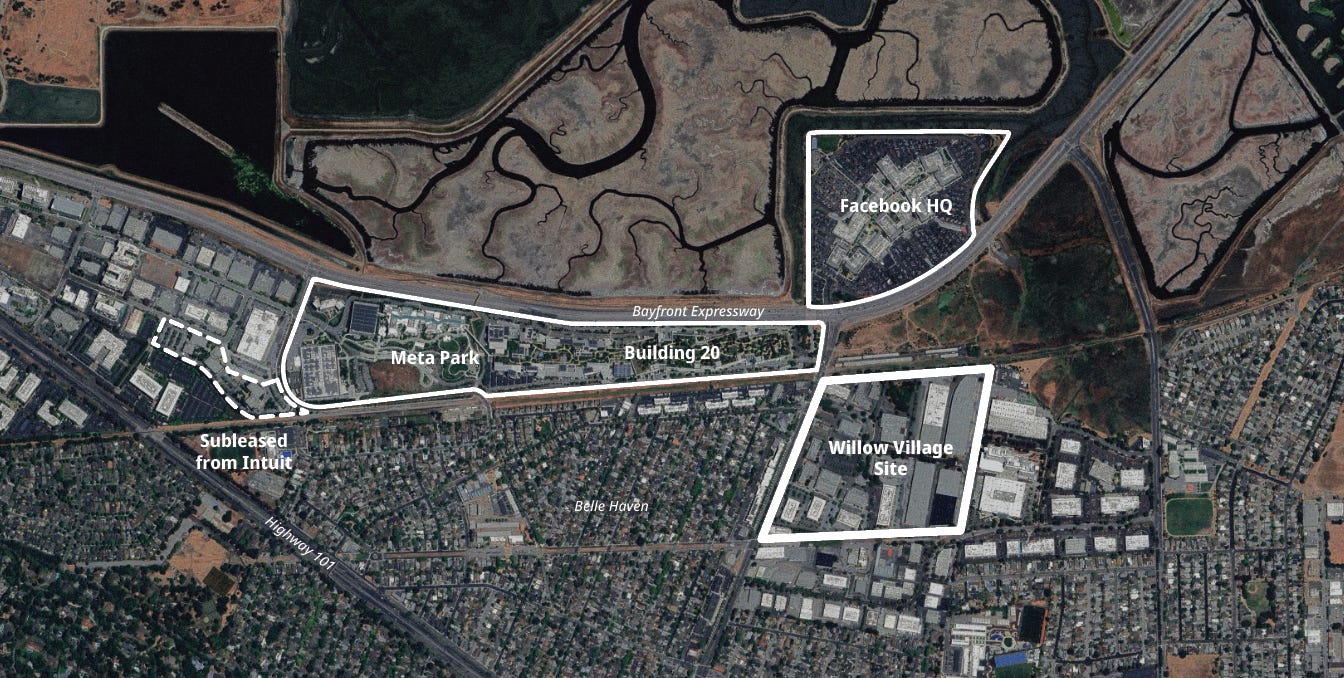
By 2018, however, the staggering scale of the corporate expansion began to clash with this narrative of neighborhood improvement. Executives informed city officials that the company expected its local workforce to reach 35,000 within a decade—a figure exceeding the entire population of Menlo Park. Willow Village alone would absorb 9,500 employees, while adjacent projects added thousands more. Former Planning Commissioner Patti Fry raised alarms, warning that the massive influx could trigger demand for 12,000 homes and severely worsen the city’s jobs-housing imbalance. The promised grocery store and pharmacy were not standalone gifts; they were attached to a massive employment machine.
To counter these growing anxieties, the 2019 project updates intensified the imagery of public urbanity. Marketing materials highlighted a vibrant Main Street, a town square, parks, and recreation fields, explicitly placing the new grocery store and pharmacy right next to the historically underserved Belle Haven neighborhood. Meta described the revised layout as “more open and inclusive,” even as the plan preserved 1.75 million square feet of office space. This design strategy worked. In December 2022, after years of intense bargaining, Menlo Park officially approved the project. The final development agreement split the village into three subdistricts, creating a hybrid instrument that served simultaneously as a public plan, a corporate growth engine, and a neighborhood benefits package.
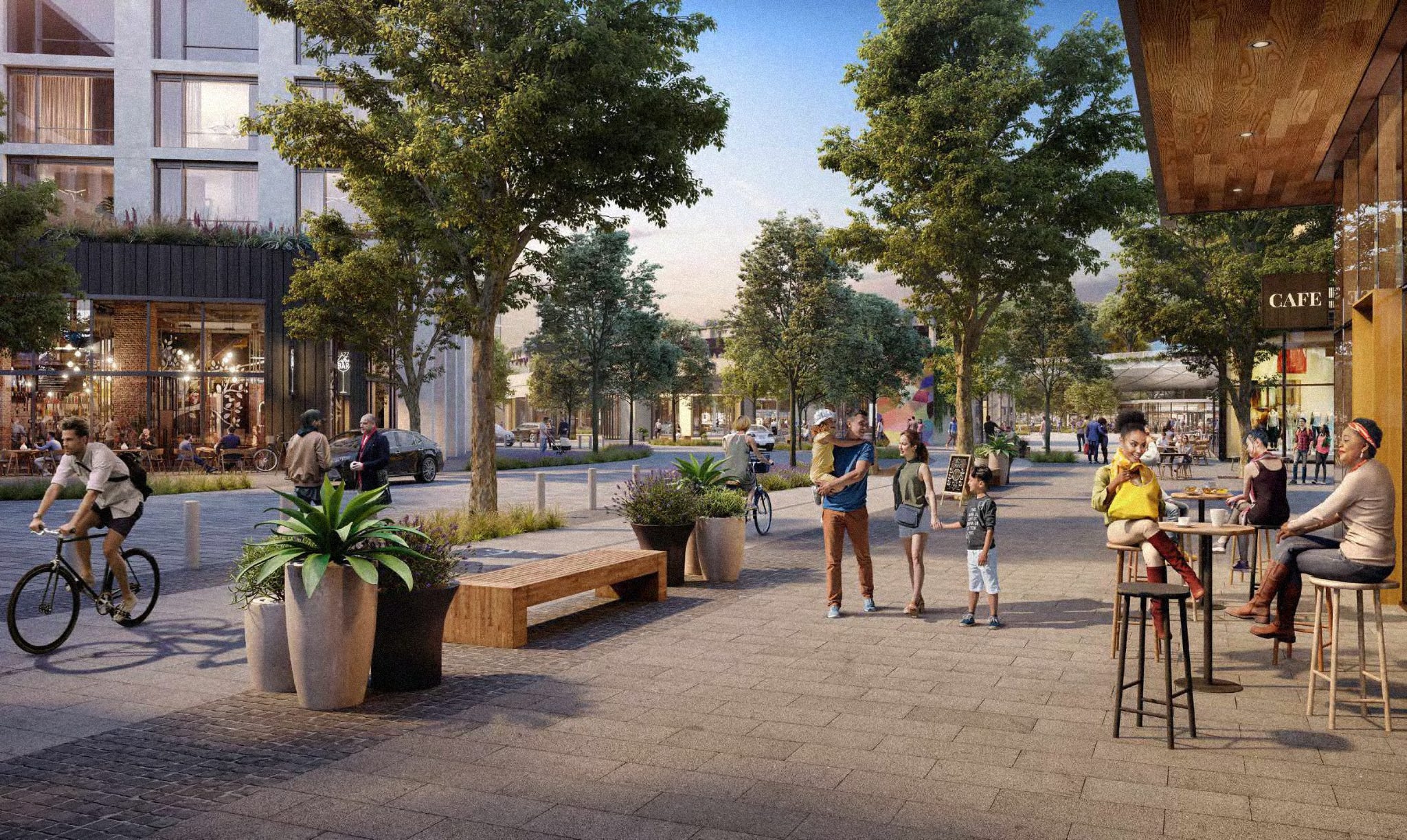
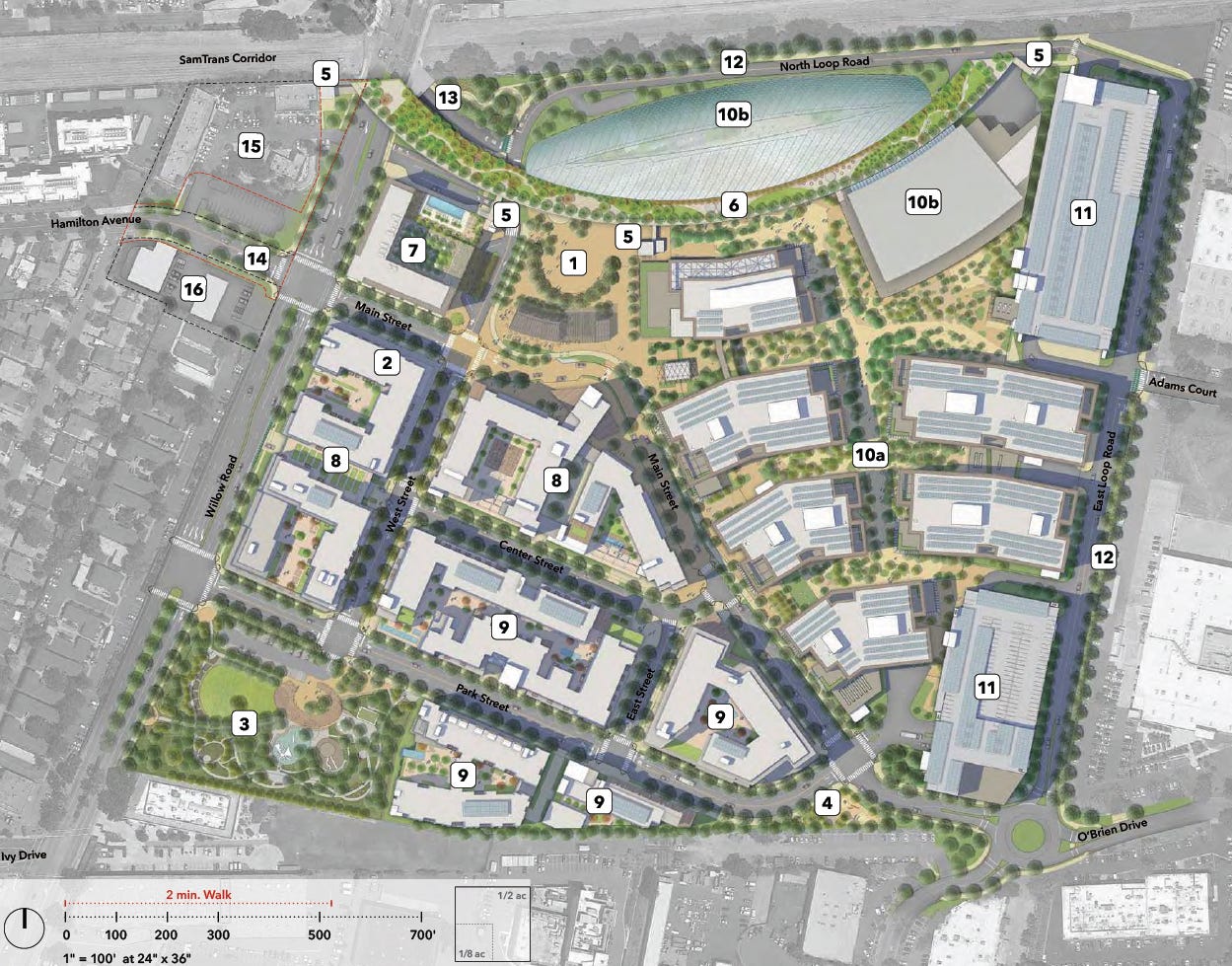
The structural flaws in this partnership only became clear when the market turned. While the 2022 agreement granted Meta immediate development certainty and vested rights, the actual delivery of the neighborhood benefits remained tied to future construction milestones. By the 2026 compliance review, with the project abruptly paused, 24 of Willow Village’s 30 development terms sat idle, categorized as conditional or requiring no action. Because the agreement remains legally valid until 2032, the project provides Meta with political credit and long-term security, while leaving the community with none of the material improvements that justified its approval in the first place.
The Dispersed Apparatus of Local Power
Willow Village represents only the most visible edge of Meta’s local influence. Over the past decade, the tech giant has quietly woven itself into almost every corner of Menlo Park’s civic life. The trend began with an explosive hiring boom. By 2017, Meta had become the city’s largest private employer, expanding its local workforce by 54 percent in a single year to 9,350 workers. This rapid influx strained the small municipality’s resources. Local officials watched with growing anxiety as corporate growth outpaced public revenue, leaving the city to scramble for the funds needed to manage the resulting traffic, infrastructure demands, and emergency services.
This corporate expansion quickly triggered a severe regional housing crisis. High-income workers flooded an already starved housing market, driving up costs and forcing out long-term residents. Between 2011 and 2015, home prices in East Palo Alto and Belle Haven skyrocketed by 130 percent, while average rents for one-bedroom apartments jumped 89 percent. The company even offered $10,000 relocation bonuses to employees who moved near the campus, a program it eventually scrapped after critics pointed out it was accelerating displacement. This displacement risk exposed a bitter irony within neoliberal urban economics—the firm’s growth actively eroded the affordability of the surrounding neighborhoods, turning corporate expansion into a source of local instability.
As public infrastructure lagged behind this growth, Meta stepped in to finance the civic repairs the city could no longer afford on its own. The Belle Haven Community Campus, which opened in 2024, serves as a prime example. The $65 million facility united the local library, pool, youth center, and senior center under one roof, with Meta funding $40 million of the total cost. Juan Salazar, Meta’s director of public policy, framed the project as an effort to advance the community’s vision through “years of community conversations”. While the community center provides a vital public space, its funding mechanism reveals a deeper structural reality. Uneven public investment created a vacuum that Meta filled, translating its wealth into local civic legitimacy.
This blurring of public good and private capital extended directly to the land itself. Meta Park, a 2.2-acre green space nestled between Chilco Street and Bayfront Expressway, functions as a vital pedestrian and bike link connecting Belle Haven to the Bay Trail. Yet the city explicitly notes that this space is privately owned, and its official website directs visitors to Meta’s own corporate rules and regulations. This is not the heavy-handed company town of the industrial era. Instead, it is a subtler arrangement—a privately owned public realm where community access remains entirely dependent on corporate property rights and corporate permission.
The most acute example of this institutional overlap occurred in public safety. In 2014, the company spent $200,000 to build a police substation near its campus and committed another $200,000 annually to fund a community safety officer. Police Chief Bob Jonsen praised the deal as a “win-win-win,” while then-Mayor Ray Mueller argued it would build community trust. By 2017, the arrangement expanded significantly when the City Council debated an $11.2 million corporate proposal to fund a six-person police team dedicated to the area around the campus.
To avoid public backlash, council members framed the money as a voluntary tax alternative to bypass perceptions of “pay for play.” One local activist expressed concern “about a private corporation that is going to be funding public officials. … Instead of being beholden to the public, public servants will be beholden to a private company.” Yet, the mayor and city council later approved a corporate-funded “Facebook Unit”, solidifying a system where public law enforcement was tied directly to corporate security priorities.
The dangers of relying on this privatized social safety net became painfully clear at the end of the 2025–26 school year. The Primary School, an educational initiative in East Palo Alto and the East Bay backed by the Chan Zuckerberg Initiative, abruptly announced it would close both its campuses. While the philanthropic organization pledged a $50 million transition fund to cushion the blow for local families, the sudden closure highlighted the inherent volatility of private social provision. This educational venture was legally separate from Meta’s municipal development agreements, yet it operates within the exact same power dynamic. Local families and public agencies are forced to organize their lives around private investments, only to absorb the disruption when the donors decide to alter their strategies.
Ultimately, Meta’s presence in Menlo Park operates not through direct political control, but through a dispersed, effective apparatus of local power. The company has successfully converted its corporate needs into public initiatives. Corporate growth became fiscal pressure; campus security became public policing; civic neglect became corporate philanthropy. Meta does not need to control City Hall to get its way. By embedding itself into the funding of parks, schools, police, and community centers, the firm has reshaped the very terrain on which the city makes its choices.
Silicon Valley’s Regional Blueprint
This structural trap is a regional governance strategy rather than an isolated Menlo Park anomaly. Google’s massive Downtown West project in San Jose offers a direct parallel to the Willow Village collapse. Approved in 2021, the 80-acre San Jose development secured immense local entitlements by promising a sweeping package of 4,000 affordable housing units, anti-displacement funds, and public parks.
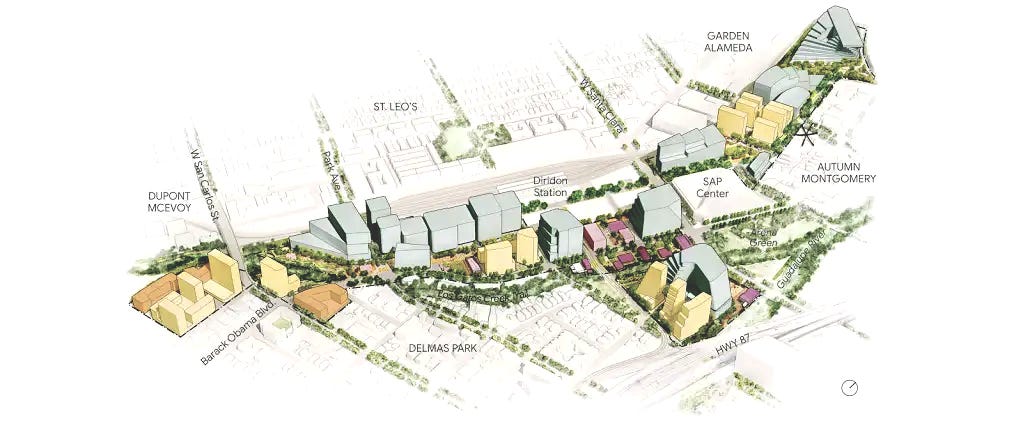
Yet, the underlying legal framework contained the exact same vulnerability. The agreement did not obligate Google to build the campus (page 78); it vested Google’s right to build while allowing Google to pace, phase, delay, or not complete development subject to limited milestone consequences. The largest community-benefit funds depended structurally on office delivery, especially office completion milestones (Exhibit C1 and H). When Google subsequently stalled the project, it proved that across Silicon Valley, municipalities are using identical legal instruments that prioritize corporate flexibility over public certainty. Corporate-dependent municipalism operates as a systemic regional blueprint, converting municipal planning departments into waiting rooms for tech capital.
As the Silicon Valley Index indicates, the region consistently generates staggering wealth and severe housing displacement from the exact same economic engine. By the start of 2026, artificial intelligence firms had captured $92 billion in regional venture capital, pushing billionaire wealth in the area toward $1.1 trillion, with the top 10 percent of households controlling 75 percent of all liquid wealth. Meanwhile, the median price for a single-family home soared to $1.98 million. This hyper-inflation leaves 44 percent of local renters spending more than 30 percent of their income on housing, while 21 percent spend more than half. Megaprojects like Willow Village are pitched as benevolent cures for this structural stress, yet they remain fundamentally dependent on the very corporate growth engine that drives the crisis.
California’s regulatory state attempts to discipline this volatile system through its mandatory Housing Element process, which forces municipalities to secure housing capacity for all income levels. However, this bureaucratic mandate creates a glaring practical paradox: the state can legally compel Menlo Park to map out housing sites, but it possesses no power to force a private corporation to actually build them. The state housing department recognized this vulnerability long before the current freeze. In its 2022 review of Menlo Park’s planning drafts, the state explicitly warned local officials to account for market barriers and buildout horizons, “particularly the 1,729 units in Willow Village,” because the city's compliance math relied too heavily on a single corporate development.
To bridge the gap between state mandates and corporate land control, municipalities have accepted an updated version of the historic company town. In the classical company town, a single firm owned the houses, hired the police, collected the garbage, and directly administered daily life—partly to provide amenities where none existed and partly to assert control over employees. The contemporary tech-driven model is more selective—fitting into the gaps that neoliberal urban policy carved out. A platform giant like Meta does not need to own every street or school in Menlo Park. Instead, the corporation selectively promises to fund or build the exact pieces of civic infrastructure that its own explosive expansion strains. The municipality then folds these private promises directly into its long-term public planning, service provision, and community expectations.
The Spatial Pivot—Compute vs. Campus
The timing of Meta’s current pause exposes the real driver of this shift. While Meta blamed “shifting real estate market conditions” for halting its housing and retail plans, its first-quarter 2026 financial results revealed an incredibly flush corporate treasury: $56.31 billion in quarterly revenue, over $81 billion in cash reserves, and a workforce of nearly 78,000 employees. The company’s capital did not evaporate; it simply changed its physical coordinates. Meta simultaneously increased its 2026 capital expenditure forecast to a staggering $125–145 billion, diverting its billions into data centers, specialized chips, and energy grids to anchor its future artificial intelligence capacity.
This reallocation marks a critical evolution in platform capitalism.5 The corporate urbanism of the 2010s relied heavily on the physical campus footprint to gather, curate, and extract productivity from knowledge workers within a centralized metropolitan space. In 2026, corporate accumulation is rapidly decoupling from this local geographic footprint. By abandoning the built environment of local communities to fund the non-urban, energy-intensive architecture of the cloud, Meta demonstrates that compute infrastructure has superseded campus real estate as the primary vector of tech capital.
This spatial pivot leaves municipalities holding empty zoning documents and half-baked housing plans. The core issue is not that mixed-use developments are inherently flawed, or that local residents were wrong to want the promised grocery stores and housing units. The failure lies in the institutional arrangement itself. When a city treats corporate real estate strategies as a substitute for independent public capacity, public goods are turned into speculative bets.
Development agreements turn into waiting rooms for private capital, and privately owned public spaces redefine civic access through the lens of corporate property relations. The ultimate failure of Willow Village is not just that Meta stopped building a neighborhood, but that Menlo Park allowed its housing compliance, neighborhood services, and civic future to depend on whether Meta still wanted to build one.
References
Molotch, Harvey L. 1976. “The City as a Growth Machine.” The American Journal of Sociology 82 (2): 309–32.
Harvey, David. 1981. “The Spatial Fix—Hegel, von Thunen, and Marx.” Antipode 13 (3): 1–12.; Harvey, David. 2001. “Globalization and the ‘Spatial Fix.’” Geographische Revue 3 (2): 23–30.
Harvey’s account of urban entrepreneurialism describes cities competing for investment through public-private projects, speculative development, and place-making; Brenner and Theodore’s “actually existing neoliberalism” clarifies that neoliberalization reorganizes, rather than withdraws, state power. See Harvey, David. 1989. “From Managerialism to Entrepreneurialism: The Transformation in Urban Governance in Late Capitalism.” Geografiska Annaler. Series B, Human Geography 71 (1): 3–17.; Brenner, Neil, and Nik Theodore. 2002. “Cities and the Geographies of ‘Actually Existing Neoliberalism.’” Antipode 34 (3): 349–79.
Swyngedouw’s “governance-beyond-the-state” helps frame multi-actor governance arrangements in which public agencies, firms, community groups, consultants, and philanthropic actors participate, but with uneven influence. See Swyngedouw, Erik. 2005. “Governance Innovation and the Citizen: The Janus Face of Governance-beyond-the-State.” Urban Studies 42 (11): 1991–2006.
Tan, J. S., and Kathleen Thelen. 2025. “Cloud Capitalism and the AI Transition.” Politics & Society, no. 00323292251396395 (December). https://doi.org/10.1177/00323292251396395.